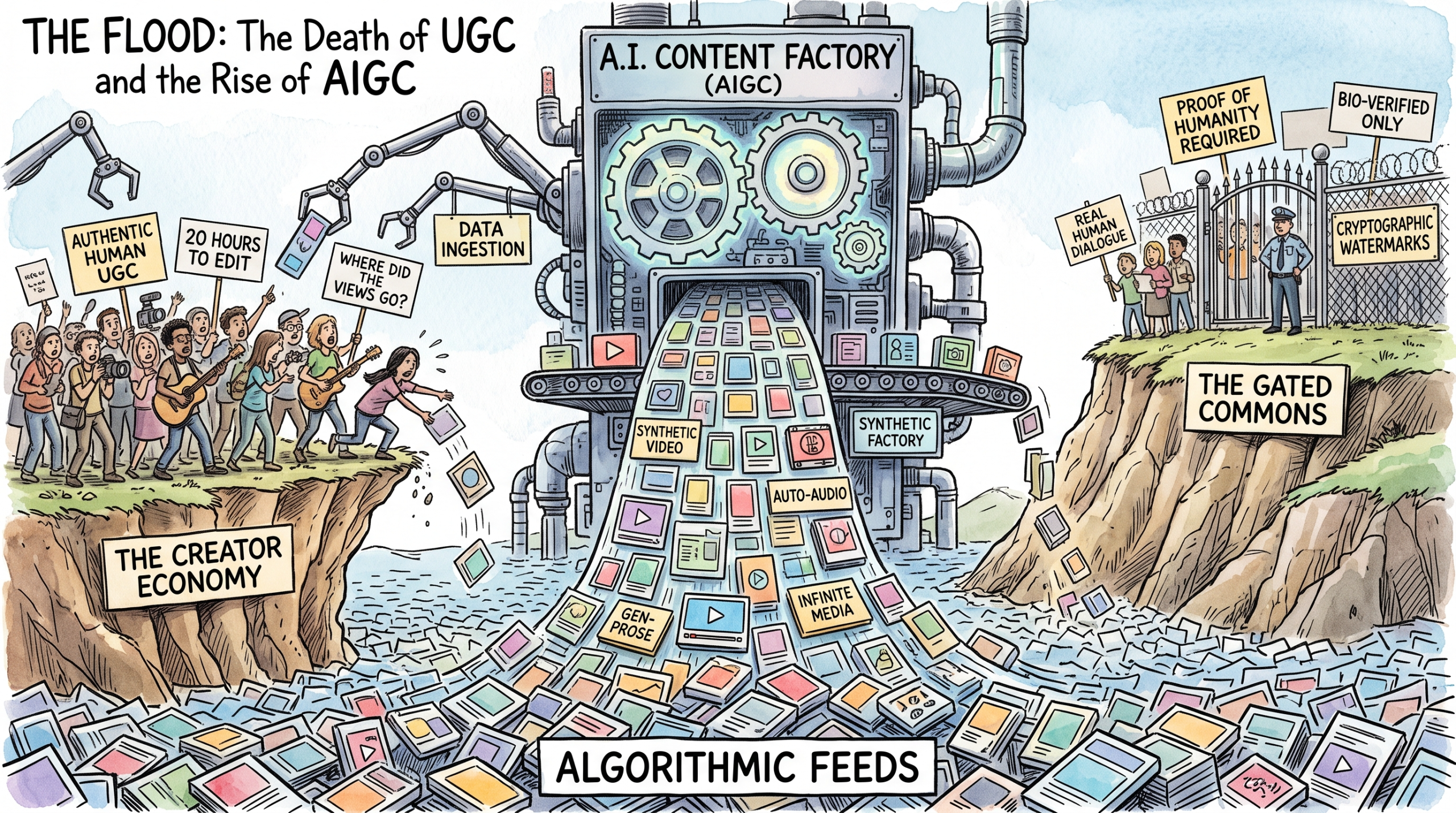
For more than two decades, the open web was defined by a single architectural premise: the democratization of production. The transition from Web 1.0 to Web 2.0 turned passive consumers into active publishers, fueling the explosion of User-Generated Content (UGC) across YouTube, Reddit, Instagram, and TikTok. Today, that era is colliding with an irreversible inflection point. The democratization of human effort is being superseded by the automation of creation itself, marking the twilight of unmediated UGC and the structural dominance of Artificial Intelligence-Generated Content (AIGC).
The Economic Collapse of Production Costs
The defining vulnerability of UGC has always been its reliance on human friction. Producing compelling video, original prose, curated photography, or educational tutorials requires cognitive labor, specialized equipment, and non-negotiable time. AIGC dismantles this constraint entirely by reducing the marginal cost of content generation to near-zero.
Where an independent creator once required days to script, shoot, and edit a short documentary, multimodal generative models produce cinema-grade video, synthetic voiceovers, and algorithmic sound design within minutes. This shift has severed the historical link between creative output and human work hours. As platforms optimize for maximum engagement per millisecond, algorithms care little whether a video originated in a bedroom studio or an enterprise compute cluster; they simply prioritize retention. When machine generation can test, iterate, and deploy ten thousand variations of a video faster than a human can frame a single shot, human-scale production faces an insurmountable volume disadvantage.
The Flooding of Digital Commons
The transition from UGC to AIGC has fundamentally altered the digital landscape:
- Algorithmic Arbitrage: Platforms that once split ad revenues with human creators are increasingly incentivized to surface synthetic assets that bypass creator payouts entirely, streamlining platform margins.
- The Erosion of Consensus Feeds: Public comment sections, forum threads, and micro-video channels are increasingly populated by autonomous personas capable of maintaining synthetic conversations, diluting authentic community discourse.
- Hyper-Personalized Feeds: Rather than matching a user with an existing human-made video, emerging distribution systems dynamically generate media tailored to the exact psychological profile, narrative pacing, and aesthetic preferences of a single viewer in real time.
This influx has turned public platforms into high-volume synthetic streams, accelerating what digital anthropologists describe as the industrialization of the feed. The casual, unpolished authenticity that powered early blogging, vlogging, and citizen journalism is being drowned out by high-fidelity synthetic ubiquity.
The Scarcity Inversion: Authenticity as a Premium Asset
When synthetic content becomes infinite, human provenance becomes the only scarce economic commodity. The rise of AIGC is not eliminating human expression; it is fundamentally restructuring its value and where it lives.
As algorithmic feeds saturate with machine-generated media, audience behavior is fracturing along clear lines. Mass-market, passive entertainment—background music, ambient visuals, explanatory listicles, and disposable short-form entertainment—is being ceded almost entirely to AIGC pipelines. Conversely, verifiable human experience is retreating behind cryptographic watermarks, biological verification systems, and closed digital communities.
The era when an amateur creator could point a smartphone at their daily life and organically capture millions of distributed eyeballs is ending. In the emerging digital economy, UGC is shifting from the default currency of the open web into an intentional, highly protected luxury: real humans speaking to real humans in gated, verifiable spaces, while the vast ocean of public feeds runs on autonomous code.
Leave a Reply